 Skip to content
HOME EV CHARGER INSTALLATION IN CONNECTICUT
Professional Level 2 EV Charger Installation by Local Licensed Electricians
Buying an electric vehicle is exciting. Figuring out how to charge it at home shouldn’t be complicated.
At Limitless Electric, we install Tesla Wall Connectors, Emporia, ChargePoint, and other compatible home EV chargers. Our licensed electricians evaluate your electrical panel, available capacity, and the best location for the charger before recommending an installation.
We prefer hardwired Level 2 chargers for many homes because they provide a permanent connection, support higher charging output with compatible equipment, and eliminate the plug-and-outlet connection.
Whether your home already has a 200-amp service or needs an electrical upgrade, we’ll explain your options and provide upfront pricing before starting the work.
No salespeople, no pressure. Just experienced electricians who take pride in doing the job right.
- 2-Hour Appointment Windows
- Transparent Pricing
- No Salespeople

Thinking About Installing an EV Charger at Home?
Having a Level 2 EV charger at home makes charging more convenient. Instead of relying on public charging stations, you can plug in when you get home and have your vehicle ready for your next drive.
We’re a locally owned electrical company based in Windsor Locks, Connecticut, serving homeowners throughout Hartford and Tolland Counties and nearby communities in Massachusetts.
We install Tesla Wall Connectors, Emporia chargers, ChargePoint equipment, and compatible customer-supplied chargers.
Before installation, we look at more than just where the charger will go. We evaluate your electrical service, existing panel, household electrical demand, and the wiring route.
Our goal is to recommend a charging setup that works well for your vehicle and makes sense for your home’s long-term electrical needs.
Other Electrical Services You May Need:
Don't Just Take Our Word for It.
See what Connecticut homeowners have to say about their experience with Limitless Electric.
What's Included in Your Home EV Charger Installation?
Installing an EV charger involves more than mounting equipment on a wall and running a wire.
A properly planned installation starts with understanding your home’s electrical system and the requirements of the charging equipment.
Electrical Panel & Load Assessment
We evaluate your existing electrical service, panel capacity, and household electrical loads to determine what charging setup your home can support.
If additional capacity is needed, we’ll explain whether load management or a panel and service upgrade makes sense.
Dedicated 240-Volt Charging Circuit
We install the wiring and circuit protection required for your charger.
For compatible hardwired equipment, a 60-amp circuit can support up to 48 amps of charging when the home and vehicle can accommodate that configuration.
Hardwired EV Charger Installation
Hardwired chargers are our preferred long-term setup for many homeowners.
They eliminate the plug-and-receptacle connection and can provide higher charging output with compatible equipment.
We’ll select the appropriate wiring, circuit protection, and charger settings for your installation.
EV-Rated NEMA 14-50 Outlets
Already have a compatible plug-in charger? We can install an EV-rated NEMA 14-50 outlet when it’s appropriate for your equipment and electrical system.
We use receptacles suitable for EV charging and install the required circuit protection.
Plug-in charging can be a good solution, but there are differences in charging capacity, connection design, and GFCI requirements that homeowners should understand.
Charger Placement & Wiring Route
Whether the charger is near your electrical panel or across the garage, we’ll evaluate the location and plan the wiring route.
Longer installations may require additional wiring, materials, and labor.
Permits, Inspections & Testing
We handle applicable permits and coordinate required inspections.
Before completing the installation, we’ll test the equipment and help you understand how to operate your new charging setup.
Why We Recommend Hardwired EV Chargers
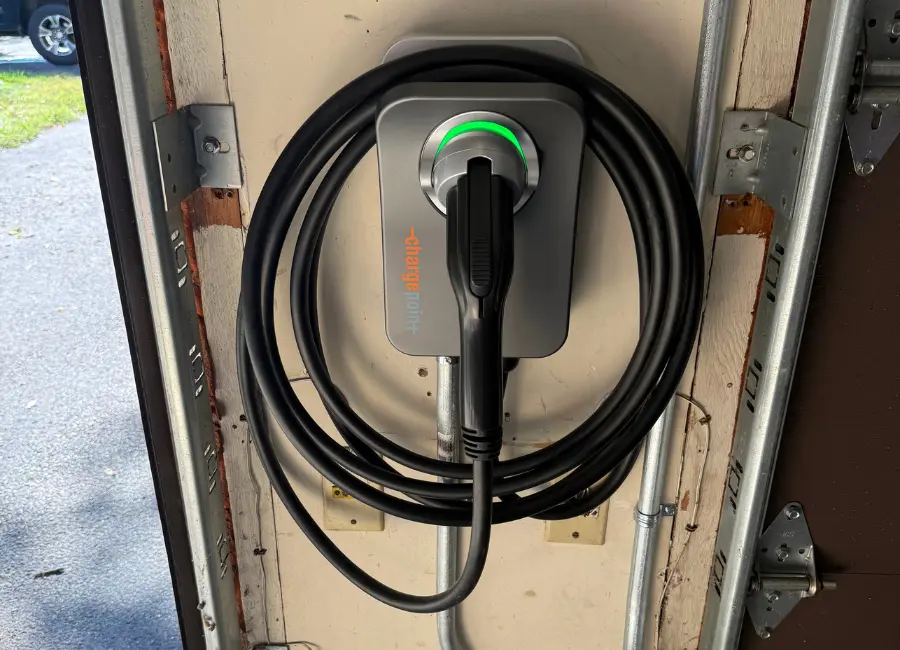
For homeowners who plan to charge regularly at home, we generally prefer a hardwired Level 2 charger.
There’s no plug connection between the charger and the wall outlet, and compatible equipment can often be configured for higher charging output.
A hardwired Tesla Wall Connector or Emporia charger, for example, may support up to 48 amps on an appropriately sized 60-amp circuit.
Another important consideration is GFCI protection.

Why Plug-In EV Chargers Can Trip GFCI Breakers
EV charging equipment includes built-in electrical safety protection. Plug-in installations using receptacles such as NEMA 14-50 also require GFCI protection where applicable under electrical code.
With some chargers, the protective electronics inside the equipment and an upstream GFCI breaker can interact in ways that cause nuisance tripping.
That means charging may stop even when there isn’t an obvious problem with the vehicle.
This doesn’t happen with every charger, but manufacturers including ChargePoint and Emporia acknowledge the possibility.
For this reason, we often recommend a manufacturer-approved hardwired installation when it makes sense for the home and local electrical requirements.
We never recommend removing required electrical protection just to stop a breaker from tripping. The correct solution is to evaluate the equipment and installation and follow applicable electrical codes.
Real EV Charger Installations We've Completed Locally
Every home is different. Some already have the electrical capacity needed for a straightforward installation. Others benefit from a service upgrade or a more carefully planned wiring route.
Here are three examples from homes we’ve worked on.
ChargePoint Level 2 Charger — Suffield, CT
A homeowner in Suffield had purchased a new Toyota electric vehicle and already had a plug-in ChargePoint Level 2 charger.
Because the home had an existing 200-amp electrical service, we were able to complete a relatively straightforward installation using a NEMA 14-50 outlet.
This was a good example of a plug-in installation making sense for the equipment the homeowner already owned.
Not every customer needs a hardwired charger. The important thing is choosing an installation that matches the equipment and the home’s electrical capacity.
Tesla Wall Connector — Longmeadow, MA
At a home in Longmeadow, Massachusetts, we installed a Tesla Wall Connector inside the garage.
The home had an existing 200-amp SPAN electrical panel, but the installation required approximately 90 feet of wiring to reach the charger location.
We installed a dedicated 60-amp circuit using 6/2 metal-clad cable, allowing the Wall Connector to be configured for up to 48 amps of charging with a compatible vehicle.
This project shows why wiring distance, electrical capacity, and proper circuit design are important parts of an EV charger installation.
Tesla Wall Connector & 200-Amp Service Upgrade — Granby, CT
For a homeowner in Granby, we completed a 200-amp electrical service upgrade as part of a Tesla Wall Connector installation.
The charger was designed for a 60-amp circuit configuration.
Rather than looking at the charger alone, we addressed the home’s electrical service and its ability to support the new load.
Upgrading the service provided additional electrical capacity and modernized the home’s service equipment for current and future electrical needs.
Should You Upgrade From 100 Amps to 200 Amps Before Installing an EV Charger?
Many older homes throughout Connecticut still have 100-amp electrical services.
When those homes were built, the electrical demands were often very different from what homeowners have today.
Electric ranges, dryers, water heaters, air conditioning, and now electric vehicles can all add to the demand on a home’s electrical system.
If you have an older 100-amp service, we strongly recommend having its condition and capacity evaluated before installing a higher-output EV charger.
In many cases, upgrading to a modern 200-amp electrical service is a worthwhile long-term improvement, especially if the existing equipment is aging or you plan to add more electrical appliances.
Your Main Breaker Matters
Your main breaker is an important part of your home’s electrical protection system. It provides overcurrent protection for the service equipment within its rated application.
But simply installing a larger breaker doesn’t increase your home’s available electrical capacity.
A proper service upgrade may involve changes to the service conductors, meter equipment, panel, grounding and bonding, and utility coordination.
That’s why we evaluate the complete electrical service rather than focusing only on the size of the breaker.
Does Every 100-Amp Home Need an Upgrade?
No. Some homes can safely support EV charging with a lower charging current or an approved load management system.
The right answer depends on the existing electrical loads, equipment condition, available capacity, and the homeowner’s future plans.
Our job is to explain those options so you can make an informed decision.
Why Choose Limitless Electric for EV Charger Installation?
We’re a locally owned, family-operated electrical company based in Windsor Locks, Connecticut.
Since 2021, we’ve helped homeowners throughout Hartford and Tolland Counties with electrical repairs, panel replacements, service upgrades, and EV charger installations.
When you contact us, you’re working with experienced, licensed electricians—not salespeople.
We’ll look at your electrical system, explain your options, and give you upfront pricing.
We offer convenient 2-hour appointment windows, and your electrician will call approximately 20–30 minutes before arriving. You’ll also receive a text with a live tracking link.
We handle applicable electrical permits and inspections, take pride in our workmanship, and stand behind eligible residential installations with our lifetime craftsmanship warranty.
Our goal isn’t simply to install your charger. It’s to make sure the electrical work is done properly and give you a company you can rely on when you need us again.
Frequently Asked Questions About EV Charger Installation
What is the difference between Level 1 and Level 2 EV charging?
Level 1 charging uses a standard 120-volt household outlet and typically adds about 3–5 miles of range per hour. Level 2 charging uses a 240-volt circuit and can add approximately 20–40 miles of range per hour with many common home charging setups, depending on the vehicle and charger.
For homeowners who drive regularly, a Level 2 charger offers the convenience of faster overnight charging without relying on public charging stations.
Is a hardwired EV charger better than a plug-in charger?
For many permanent home installations, we prefer hardwired charging. It eliminates the plug-and-receptacle connection and can support higher charging output with compatible equipment.
However, an EV-rated NEMA 14-50 outlet can still be a good option for compatible plug-in equipment.
Why does my EV charger keep tripping the GFCI breaker?
Some plug-in EV chargers have built-in ground-fault protection that can interact with the GFCI breaker protecting the receptacle circuit.
This can cause nuisance tripping in certain installations. However, a tripping breaker can also indicate an actual electrical fault.
Our electricians can evaluate the installation and determine the appropriate solution. Required GFCI protection should never be bypassed.
Does an EV charger need a GFCI breaker?
Plug-in EV charging receptacles generally require GFCI protection under applicable electrical codes.
Hardwired chargers have different installation requirements, and many include manufacturer-specified internal protection.
We follow the applicable electrical code and the charger’s installation instructions for each project.
Can I charge at 48 amps with a NEMA 14-50 outlet?
A typical 50-amp NEMA 14-50 EV charging circuit supports up to 40 amps of continuous charging with compatible equipment.
A hardwired charger on an appropriately sized 60-amp circuit may support up to 48 amps.
The actual charging rate also depends on your vehicle.
Do I need a 200-amp electrical service?
Not necessarily. We evaluate the electrical loads and condition of your existing service.
We often recommend considering a 200-amp upgrade for older homes with limited capacity or plans for additional electrical equipment.
Some homes can use lower-output charging or load management without upgrading.
Can you install my Tesla Wall Connector?
Yes. We install Tesla Wall Connectors, including compatible 60-amp circuit configurations for up to 48-amp charging.
We also install Emporia and ChargePoint equipment.
Can you install a charger I already purchased?
Yes. We install compatible customer-supplied charging equipment. We’ll review the model and installation requirements before proceeding.
How much does a home EV charger installation cost?
The cost depends on the charger type, distance from the electrical panel, wiring route, available electrical capacity, and whether additional electrical upgrades are required.
We’ll evaluate your home and provide upfront pricing during your scheduled visit.
Do you handle permits and inspections?
Yes. We handle applicable electrical permits and coordinate required inspections for our installations.
Do you offer an installation warranty?
Yes. Our eligible residential installation workmanship is covered by our lifetime craftsmanship warranty. Charger equipment is covered by the applicable manufacturer’s warranty.

Areas We Serve
These are our primary service areas. We serve throughout Hartford County, Tolland County, and many surrounding communities; contact us to confirm availability.
Ready to Charge Your EV at Home?
Whether you already have a charger or need help choosing one, Limitless Electric can help you plan an installation that fits your home.
We’ll evaluate your electrical system, explain your options, and provide upfront pricing before work begins.
24/7 Live Answering | 2-Hour Appointment Windows | Licensed in CT & MA
CT License: ELC.0206906-E1
MA License: 23117-A
Unlock Your Home’s Potential.